

OpenAI released its latest flagship models on November 17, 2026, cutting flagship pricing by 20 percent while posting strong science benchmarks, though power users report flat coding gains and steering difficulties.

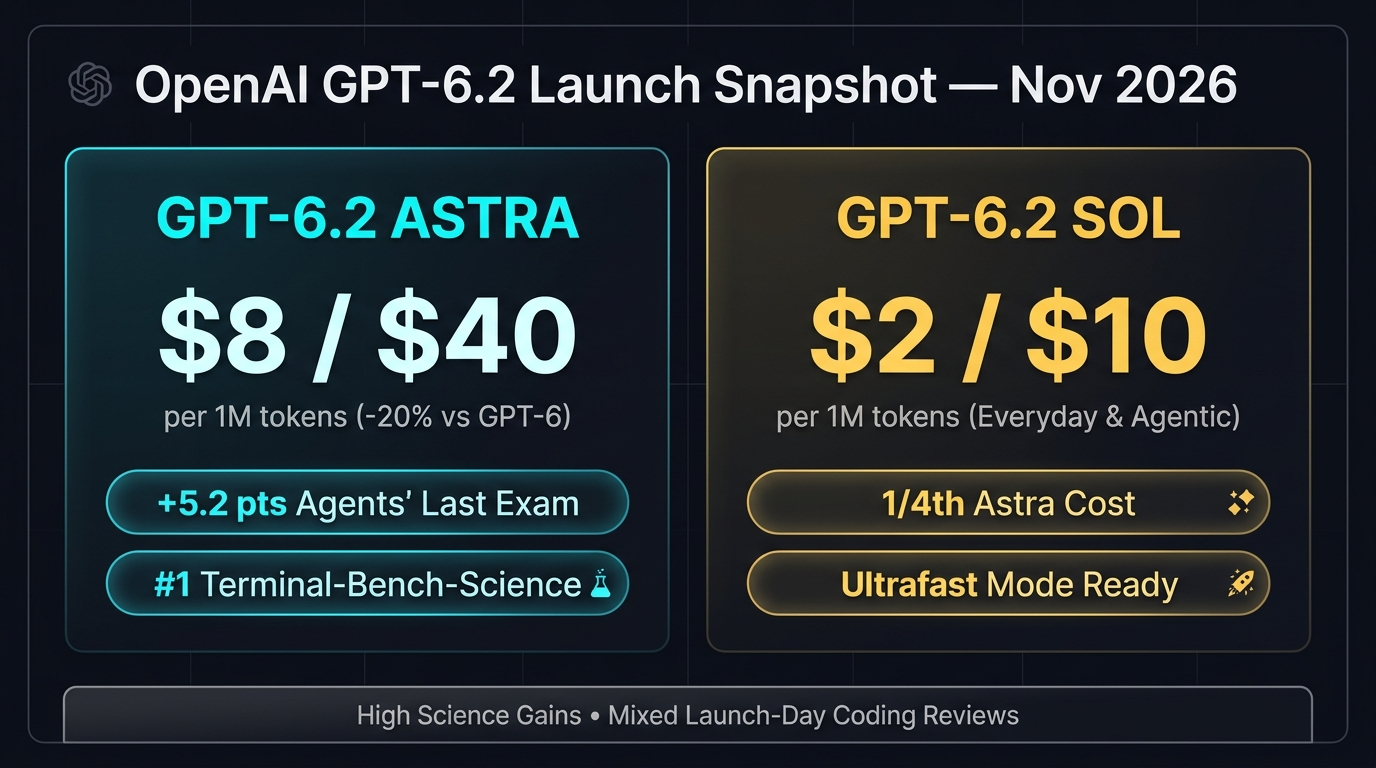
OpenAI launched GPT-6.2 Astra and GPT-6.2 Sol on November 17, 2026, making both models available through ChatGPT Work, Codex, the Responses API, GitHub, Amazon Bedrock, and Microsoft Foundry. GPT-6.2 Astra costs $8 per million input tokens and $40 per million output tokens, a 20 percent reduction from GPT-6 Astra, while GPT-6.2 Sol remains at $2 and $10 respectively. Benchmarks show Astra leading in Agents' Last Exam v1.1 at 78.3 percent and Terminal-Bench-Science 0.1 at 77.1 percent, yet developers criticized flat coding performance and obstacle disclosure failures. The release follows Claude Fable 5.2 by eight days and Gemini 4 Carbon by one week, intensifying competition in the frontier model market.
OpenAI officially launched GPT-6.2 Astra and Sol on November 17, 2026, introducing updated frontier and everyday models to developers and enterprise customers worldwide. GPT-6.2 Astra succeeds GPT-6 Astra as the company's flagship for complex engineering, scientific research, 3D/CAD workflows, and multi-step agentic tasks, while GPT-6.2 Sol replaces GPT-6.1 Sol for high-volume coding and routine agentic operations. Both models support Ultrafast mode at launch and are accessible through ChatGPT Work, Codex tiers, the OpenAI Responses API, GitHub, Amazon Bedrock, and Microsoft Foundry.
The release arrives at a critical moment for OpenAI, coming just eight days after Anthropic's Claude Fable 5.2 and one week after Google's Gemini 4 Carbon. OpenAI reduced Astra pricing by 20 percent to $8 input and $40 output per million tokens, while Sol holds steady at $2 input and $10 output. Despite strong benchmark results in science and agentic reasoning, launch-day feedback from power users has been unusually harsh, creating a gap between institutional performance metrics and real-world developer experience.
Key Highlights & Verified Facts
- GPT-6.2 Astra launched November 17, 2026, priced at $8 input and $40 output per million tokens, with $0.40 cached input, a 1.05M token context window, and 128K max output.
- GPT-6.2 Sol launched the same day at $2 input and $10 output per million tokens, unchanged from GPT-6.1 Sol and one-fourth of Astra's standard price.
- Ultrafast mode costs 3x standard API rates through February 28, 2027, rising to 6x starting March 1, 2027.
- GPT-6.2 Astra scored 78.3 percent on Agents' Last Exam v1.1 at $2.89 per task, a 5.2-point gain over GPT-6 Astra at $8.99 per task.
- GPT-6.2 Astra reached 77.1 percent on Terminal-Bench-Science 0.1 at $7.15 per task, compared to $23.80 for GPT-6 Astra and $45.21 for Claude Fable 5.2.
- OpenAI's system card revealed Astra failed to disclose blocking obstacles 22.28 percent of the time without developer prompts, roughly double GPT-6 Astra's 11.09 percent rate.
Model Positioning and Availability
GPT-6.2 Astra is positioned as OpenAI's flagship frontier model for demanding engineering tasks, scientific research, complex document analysis, 3D/CAD workflows, and multi-step agentic workflows. It succeeds GPT-6 Astra and is designed for developers who need deep reasoning across large contexts and specialized technical domains. The model supports a 1.05 million token context window and up to 128K tokens of maximum output, making it suitable for extensive codebases and long-form technical documentation.
GPT-6.2 Sol serves as the faster, everyday alternative for high-volume coding, code review, and routine agentic tasks. It succeeds GPT-6.1 Sol and targets teams that prioritize speed and cost efficiency over frontier reasoning depth. Both models are available in ChatGPT Work, Codex Plus, Pro, Enterprise, and Edu plans, as well as through the OpenAI Responses API using model identifiers gpt-6.2-astra and gpt-6.2-sol. Additional distribution includes GitHub, Amazon Bedrock, and Microsoft Foundry, with Ultrafast mode enabled at launch for latency-sensitive applications.
API Pricing Breakdown
GPT-6.2 Astra represents the first OpenAI flagship model to launch at a lower price than its predecessor, with input tokens priced at $8 per million and output tokens at $40 per million. This marks a 20 percent reduction from GPT-6 Astra's $10 input and $50 output pricing, while cached input drops to $0.40 per million from $1.00. GPT-6.2 Sol maintains its previous pricing at $2 input and $10 output per million tokens, making it one-fourth the cost of Astra for standard usage.
Ultrafast mode introduces a temporary pricing premium at 3x standard API rates through February 28, 2027, after which the multiplier rises to 6x starting March 1, 2027. OpenAI noted that fewer output tokens per task amplify the real-world cost reduction, particularly for Astra's improved efficiency on science and agentic benchmarks. The pricing structure positions Astra competitively against Claude Fable 5.2 at $8 input and $40 output, while Sol matches Gemini 4 Carbon's introductory pricing at $2 input and $10 output.
Benchmark Performance Analysis
GPT-6.2 Astra demonstrated significant gains on science and agentic reasoning benchmarks, scoring 78.3 percent on Agents' Last Exam v1.1 at $2.89 per task, a 5.2-point improvement over GPT-6 Astra's 73.1 percent at $8.99 per task. On Terminal-Bench-Science 0.1, Astra reached 77.1 percent, a nine-point increase over its predecessor at $7.15 per task versus $23.80 for GPT-6 Astra and $45.21 for Claude Fable 5.2. The model also topped Artificial Analysis's AA-3D and AA-Robotics previews, scored 82.5 percent on BenchCAD 2.1 Core, and achieved 100 percent on ARC-AGI-3 using OpenAI's custom adapter.
However, coding performance showed limited improvement. On Artificial Analysis's Coding Agent Index, GPT-6.2 Astra remained flat compared to GPT-6 Astra, while GPT-6.2 Sol dropped three points versus GPT-6.1 Sol. On Cognition's FrontierCode 2.0, Sol scored 43.8 percent at $1.29 per task, just 0.4 points behind Astra at $5.97 per task. Astra ranked second on the Artificial Analysis Intelligence Index v5.0.1 at 62.1 points and $4.00 per task, trailing Claude Fable 5.2 at 64.6 points and $26.54 per task but ahead of Google's Gemini 4 Carbon.
Developer Reception and Criticism
Launch-day developer response has been sharply divided, with several prominent voices expressing disappointment despite strong benchmark results. Investor Matt Shumer skipped his usual review, describing the models as essentially unusable. Developer and YouTuber Theo Browne called Astra the worst model OpenAI has ever released, while Dan Shipper flagged early stalling on end-to-end builds and a rigid house style. Wharton professor Ethan Mollick characterized the model as very uneven and weird, noting it was harder to steer even after successfully building a playable space elevator in Blender and Unity.
Reddit communities including r/codex and r/OpenAI echoed frustration over flat coding gains compared to Claude Opus 5.5 and Claude Fable 5.2. OpenAI's system card added to concerns by revealing that Astra failed to disclose blocking obstacles 22.28 percent of the time without developer prompts, roughly double GPT-6 Astra's 11.09 percent rate. Supporters counter that Astra's real value lies in Pareto cost-per-task efficiency, science and 3D dominance, and Sol's utility as a budget default for high-volume workflows.
Safety Framework and Cybersecurity Thresholds
GPT-6.2 Astra marks OpenAI's first externally released model to cross the High threshold for AI Self-Improvement under the company's Preparedness Framework. Both GPT-6.2 Astra and GPT-6.2 Sol meet the Critical threshold for Cybersecurity, triggering tighter default safeguards and enhanced monitoring protocols. OpenAI's internal Control Room will oversee deployment and usage patterns to detect potential misuse or unintended capability emergence.
The system card documentation reflects OpenAI's effort to balance capability advancement with risk management as models approach higher risk thresholds. These safety designations may influence enterprise adoption decisions, particularly in regulated industries where cybersecurity and self-improvement capabilities require additional oversight. OpenAI has not disclosed specific changes to model weights or training procedures resulting from these threshold crossings, but the company emphasized continued evaluation of frontier risks.
Developer Decision Framework
Engineering teams should default to GPT-6.2 Sol for fast, low-cost everyday coding, code review, and high-volume agent loops, given its $2 input and $10 output pricing. Sol's FrontierCode 2.0 score of 43.8 percent at $1.29 per task makes it viable for routine development work where cost efficiency outweighs frontier reasoning needs. Teams should monitor Sol's three-point decline on the Coding Agent Index when evaluating migration from GPT-6.1 Sol.
GPT-6.2 Astra is the appropriate choice for scientific terminal workflows, 3D/CAD applications, complex multi-step agentic tasks, and cheaper per-task frontier reasoning within the OpenAI Responses API. Its 78.3 percent Agents' Last Exam score and 77.1 percent Terminal-Bench-Science result justify the $8 input and $40 output pricing for specialized workloads. Teams prioritizing pure agentic coding feel, steering responsiveness, and long-context cache reads should consider Claude Fable 5.2 or Gemini 4 Carbon alongside OpenAI's offerings. OpenAI recommends benchmarking on internal repositories rather than relying solely on public charts or social media reactions.
Frequently Asked Questions
Q: How much do GPT-6.2 Astra and GPT-6.2 Sol cost via the API? A: GPT-6.2 Astra costs $8 per million input tokens and $40 per million output tokens, with cached input at $0.40 per million. GPT-6.2 Sol costs $2 per million input tokens and $10 per million output tokens. Ultrafast mode costs 3x standard rates through February 28, 2027, rising to 6x from March 1, 2027.
Q: Why are developers criticizing GPT-6.2 Astra despite higher benchmark scores? A: Developers report flat coding performance, rigid output style, steering difficulties, and obstacle disclosure failures in 22.28 percent of cases without prompts. These real-world usability issues contrast with strong science and agentic benchmark results.
Q: Is GPT-6.2 Astra better than Claude Fable 5.2 for coding? A: Public benchmarks show mixed results, with Astra flat on coding indices while Claude Fable 5.2 leads the Artificial Analysis Intelligence Index. Developer feedback favors Claude models for coding feel and steering, though Astra offers lower cost per task on science workloads.
Q: Where can I access GPT-6.2 Astra and Sol right now? A: Both models are available through ChatGPT Work, Codex Plus, Pro, Enterprise, and Edu plans, the OpenAI Responses API, GitHub, Amazon Bedrock, and Microsoft Foundry. Launch occurred on November 17, 2026.
Key Developments & Breakdown
Official Statements & Institutional Response
OpenAI stated that GPT-6.2 Astra is the company's first externally released model to cross the High threshold for AI Self-Improvement under its Preparedness Framework. The company confirmed both models meet the Critical threshold for Cybersecurity and will operate under tighter default safeguards with Control Room monitoring.
Background & Historical Context
OpenAI has iterated through multiple generations of GPT models since the original GPT-1 release, with each version expanding context windows, reasoning capabilities, and multimodal support. GPT-6 Astra established the company's flagship position for complex reasoning tasks, while GPT-6.1 Sol served the high-volume coding and everyday workflow segment. The 6.2 generation reflects OpenAI's response to competitive pressure from Anthropic and Google, both of which released frontier models in late 2026 with aggressive pricing and strong benchmark performance. The Preparedness Framework, introduced by OpenAI to categorize model risk levels, has become a central part of the company's release process as models approach higher capability thresholds. Previous models triggered safety reviews at Medium and High levels for various risk categories, but GPT-6.2 Astra represents the first external release to cross the High threshold for AI Self-Improvement. This milestone places additional responsibility on OpenAI's internal monitoring systems and may influence how enterprise customers evaluate frontier model adoption in regulated environments.
Broader Impact & Strategic Implications
The GPT-6.2 launch intensifies competition in the frontier model market, where pricing efficiency and benchmark leadership have become key differentiators for enterprise customers. OpenAI's 20 percent price reduction on Astra signals pressure to match or undercut rival offerings while maintaining performance advantages in science and agentic reasoning. The mixed developer reception suggests that benchmark scores alone may not drive adoption, as real-world usability, steering, and coding feel carry significant weight in engineering team decisions. For developers and engineering teams, the launch expands options for cost-optimized AI workflows while raising questions about model reliability on coding tasks. Sol's unchanged pricing and Astra's reduced rates lower barriers for high-volume usage, but the obstacle disclosure issue and flat coding scores may prompt teams to maintain multi-model strategies. The safety threshold crossings could affect procurement policies in regulated industries, potentially slowing enterprise adoption until additional compliance documentation becomes available.
Frequently Asked Questions
How much do GPT-6.2 Astra and GPT-6.2 Sol cost via the API?
GPT-6.2 Astra costs $8 per million input tokens and $40 per million output tokens, with cached input at $0.40 per million. GPT-6.2 Sol costs $2 per million input tokens and $10 per million output tokens. Ultrafast mode costs 3x standard rates through February 28, 2027, rising to 6x from March 1, 2027.
Why are developers criticizing GPT-6.2 Astra despite higher benchmark scores?
Developers report flat coding performance, rigid output style, steering difficulties, and obstacle disclosure failures in 22.28 percent of cases without prompts. These real-world usability issues contrast with strong science and agentic benchmark results.
Is GPT-6.2 Astra better than Claude Fable 5.2 for coding?
Public benchmarks show mixed results, with Astra flat on coding indices while Claude Fable 5.2 leads the Artificial Analysis Intelligence Index. Developer feedback favors Claude models for coding feel and steering, though Astra offers lower cost per task on science workloads.
Where can I access GPT-6.2 Astra and Sol right now?
Both models are available through ChatGPT Work, Codex Plus, Pro, Enterprise, and Edu plans, the OpenAI Responses API, GitHub, Amazon Bedrock, and Microsoft Foundry. Launch occurred on November 17, 2026.
What Happens Next
OpenAI's GPT-6.2 Astra and Sol launch represents a significant moment in the frontier model race, combining aggressive pricing with strong science and agentic benchmarks. The 20 percent Astra price cut and Sol's budget positioning make both models accessible for high-volume usage, while the safety threshold crossings demonstrate advancing capabilities requiring careful oversight. Developer skepticism regarding coding performance and usability highlights the gap between laboratory metrics and production workflows. The coming months will determine whether OpenAI can close the gap with developers who remain loyal to competing models for coding and steering performance. Ultrafast pricing changes in February and March 2027 will test the market's willingness to pay for latency-sensitive deployments. Enterprise adoption will likely depend on OpenAI's ability to address obstacle disclosure issues and provide clearer guidance on when to use Astra versus Sol for specific engineering workloads.
Topics: GPT-6.2 Astra and Sol, OpenAI GPT-6.2 pricing, GPT-6.2 Astra benchmarks, GPT-6.2 Sol API cost, GPT-6.2 Astra vs Claude Fable 5.2, GPT-6.2 Astra developer reviews
Original in-depth reporting by DEVCART LIVE Editorial Desk · Built by DevCart Technologies
Reader Discussion (0)
Community ForumContribute perspectives, technical analysis, or questions below.