

For the past two years, the artificial intelligence industry has been locked in a relentless race over input context windows—competing to see which model can read the largest stack of PDFs, code repositories, or video transcripts. Yet even the most advanced models hit a frustrating bottleneck the moment they had to write back, truncating responses at 64,000 or 128,000 tokens. With the release of Google Gemini 4 Argon, Google DeepMind has flipped that script entirely by pushing the single-response output ceiling to an industry-leading 1 million tokens.

Initially introduced through an unprecedented, security-first rollout under Google’s Fairwind Program before expanding across Google Cloud, the Gemini API (gemini-4-argon), Google AI Studio, and Google Antigravity, Google Gemini 4 Argon is built specifically for long-horizon reasoning. Rather than acting as a quick-turn chatbot, it is engineered to operate like a senior architect, financial analyst, legal associate, or incident responder capable of executing massive, multi-hour workflows in a single coherent trajectory.
- 1-Million-Token Output Limit: Expands single-turn output capacity nearly 16x from Gemini’s previous 64K ceiling via "Long Decode," eliminating fragile mid-task stitching.
- Security-First Rollout via Fairwind Program: Initially deployed to vetted cybersecurity defenders with lifted cyber output guardrails to find zero-day flaws and automate patching at machine speed.
- Enterprise Production Milestones: Already proved its real-world value inside Google by saving over 300 terabytes of server RAM and autonomously migrating an 800,000-line legacy C++ codebase to Rust.
- Benchmark Leadership: Posted 77.9% on DeepSWE v1.1, 91.7% on LVBench, 51.3% on Zapier AutomationBench, and a 14% enterprise knowledge accuracy gain over Gemini 3.1 Pro.
- Aggressive API Economics: Launched at $2 per million input tokens and $10 per million output tokens (transitioning to $4/$20 post-introductory pricing), paired with a 95% discount on cached input.
- Why a 1-Million-Token Output Window Changes Everything
- Inside the Architecture: Long Decode and Tunable Thinking
- Real-World Enterprise Use Cases: Coding, Legal, and Finance
- The Fairwind Program: Autonomous Cyber Defense Without Handcuffs
- Benchmarks, Pricing, and the Hidden Token Budget Trap
- Where Argon Fits in Google’s Chemical-Element Gemini 4 Family
- Frequently Asked Questions
Why a 1-Million-Token Output Window Changes Everything
To understand why Google Gemini 4 Argon is generating such intense debate among CTOs and machine learning engineers, it helps to separate reading from building. A large input window lets an AI model ingest an entire enterprise repository or a 500-page merger agreement. However, if the model can only output 64K or 128K tokens at once, any task that requires generating massive artifacts breaks down almost immediately.
Until now, developers building AI agents had to rely on brittle "harness-level stitching." When an agent ran out of output space mid-task, an orchestration script had to pause the model, summarize what it had written so far, pass that compressed memory into a new API call, and hope the model did not hallucinate variable names, forget edge cases, or lose logical continuity across the boundary.
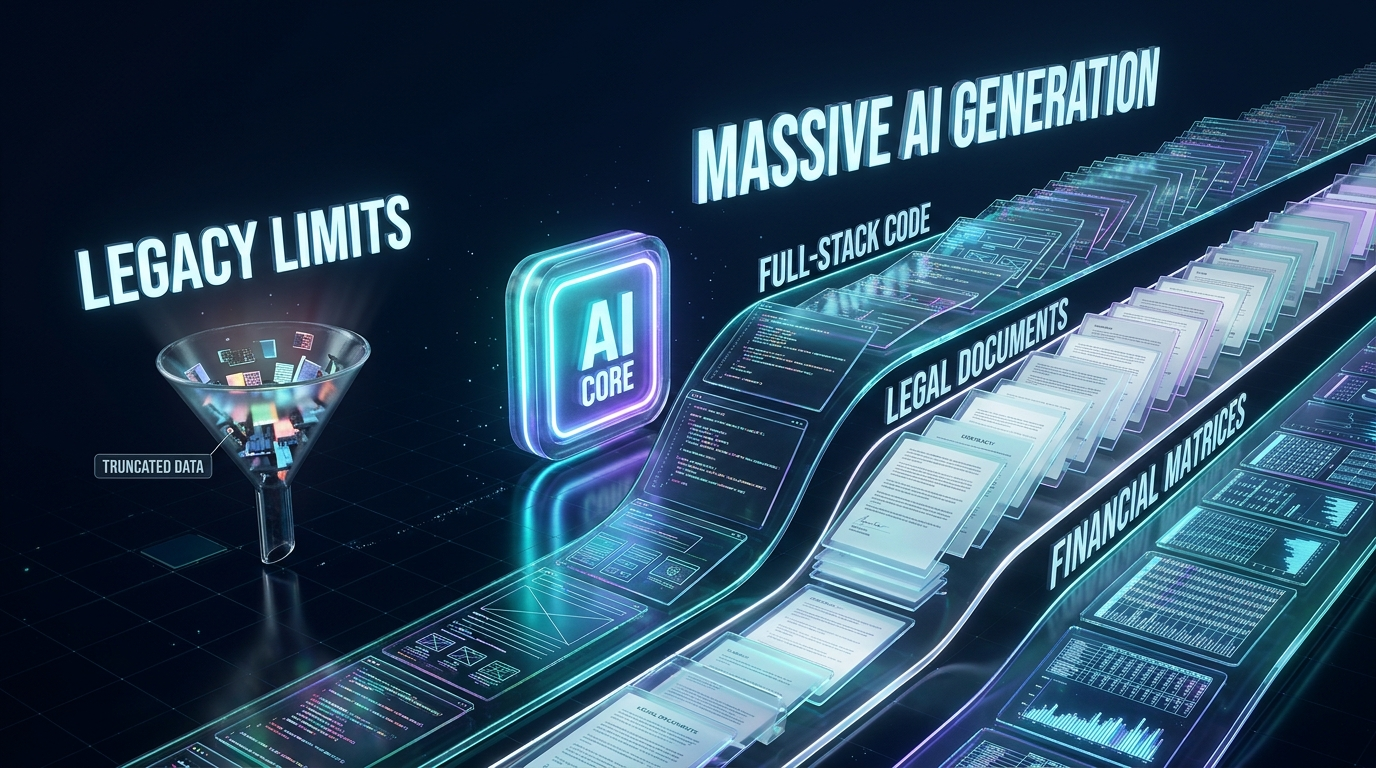
One million tokens equals roughly 700,000 to 750,000 English words—equivalent to nearly ten full-length novels or hundreds of interconnected source code files—generated in a single, unbroken stream. Because the model retains direct, uncompressed attention over every line of reasoning and output it has just produced, error compounding drops dramatically.
Inside the Architecture: Long Decode and Tunable Thinking
Generating a million coherent tokens is not merely a matter of increasing a configuration slider. Traditional transformer models suffer from severe attention drift and repetition loops when pushed past a few dozen thousand output tokens. Google engineered Google Gemini 4 Argon around a unified 1-million-token context window paired with two developer-facing controls:
- Long Decode Mode: Allows the model to stream continuous, uninterrupted generations far past the traditional 64K wall without triggering premature summarization or structural collapse.
- Tunable Thinking Levels (
low,medium,high): Because Gemini 4 Argon is a frontier reasoning model, it uses hidden internal chain-of-thought tokens to test hypotheses, verify code logic, and double-check edge cases before emitting final answers. Developers can dial thinking depth up for mission-critical architecture tasks or down for faster operational turnaround.
Real-World Enterprise Use Cases: Coding, Legal, and Finance
While consumer AI demos often focus on creative writing or quick search summaries, the true return on investment for a 1-million-token output limit sits squarely inside high-stakes enterprise industries. Here is how Google Gemini 4 Argon transforms four major verticals.
1. Heavy Software Engineering and Legacy Codebase Migrations
Enterprise engineering teams spend billions maintaining aging monolithic software written in C++, COBOL, or legacy Java. Previous models could refactor a single function or microservice, leaving humans to untangle cross-file dependencies manually.
During internal production deployments at Google, Gemini 4 Argon demonstrated what sustained, million-token generation can achieve in the real world:
- Memory Optimization at Scale: Argon analyzed complex production infrastructure and generated targeted optimizations that reclaimed over 300 terabytes of RAM across live Google server clusters.
- Autonomous Language Migration: The model autonomously migrated an 800,000-line legacy C++ operating system codebase to Rust, preserving memory safety guarantees and cross-module interfaces without human stitching.
- Performance Refactoring: By refactoring 32,000 lines of an open-source video decoder in sustained reasoning loops, Argon tripled execution performance.
2. End-to-End Legal Drafting and Due Diligence
Corporate law firms handling cross-border mergers, regulatory compliance filings, or multi-jurisdictional litigation rarely need a two-page summary—they need exhaustive, clause-consistent documentation. On Harvey’s Legal Agent benchmark and enterprise evaluations conducted by Box, Gemini 4 Argon showed a 14% accuracy jump over Gemini 3.1 Pro, connecting granular evidence across entire document rooms—including data embedded inside complex charts and figures.
With a 1M output ceiling, legal teams can generate complete redline comparisons, comprehensive M&A disclosure schedules, and exhaustive compliance matrices in a single unified pass, ensuring that a definition updated on page 12 stays mathematically and legally consistent through page 340.
3. Institutional Financial Research and Multi-Sheet Modeling
Investment banks, private equity analysts, and quantitative research desks deal with deeply interconnected datasets: SEC 10-K filings, quarterly earnings transcripts, macroeconomic tables, and multi-tab valuation models. Scoring top marks on the Vals Finance Agent v2 benchmark, Gemini 4 Argon can ingest years of historical filings and output complete, auditable investment memos, sensitivity tables, and full Python or spreadsheet-modeling scripts without silently omitting footnotes or truncating risk disclosures.
4. Multimodal Robotics and Video Intelligence
Beyond text and code, Gemini 4 Argon retains native multimodal reasoning. Scoring an impressive 91.7% on LVBench (long-form video understanding), Google has also introduced specialized robotics workflows powered by Argon, bridging visual-semantic reasoning with complex control code generation across long physical task horizons.
The Fairwind Program: Autonomous Cyber Defense Without Handcuffs
Perhaps the most defining strategic decision behind Google Gemini 4 Argon was not its architecture, but how Google chose to release it. Instead of launching directly to the general public on day one, Google routed initial access exclusively to vetted security teams through the Fairwind Program.

For years, cybersecurity practitioners complained about a frustrating paradox in AI safety: standard commercial AI models often refuse legitimate defensive tasks—such as reverse-engineering malware, simulating advanced exploits, or analyzing zero-day memory corruption—because safety filters mistake defensive research for malicious intent.
Google’s Fairwind Program addresses this bottleneck directly by creating a strictly governed, high-trust tier for defenders:
- Lifted Cyber Guardrails for Trusted Defenders: Admitted organizations receive a specialized build of Gemini 4 Argon with restrictive cyber output guardrails removed, unlocking full frontier capability for vulnerability discovery, exploitation proofing, and root-cause patch synthesis.
- Strict Enterprise Governance & Vetting: Access is not open to everyone. Google conducts organizational background checks to verify ethical security histories. Participating organizations must enforce user-level authentication, phishing-resistant MFA, strict internal access restrictions (limited to incident response, red teams, and security engineering), and comprehensive audit logging.
- No Redistribution Allowed: Fairwind partners are strictly prohibited from reselling, sharing, or exposing frontier cyber access outside authorized internal teams, and dual-use tasks are restricted strictly to authorized defense and academic research.
How 1 Million Output Tokens Transform Security Operations (SOC)
In real-world incident response, truncation is dangerous. When a Security Operations Center investigates an active breach, analysts must correlate multi-day audit logs, full PCAP network captures, decompiled binaries, and threat intelligence profiles simultaneously.
With Gemini 4 Argon’s 1-million-token output window—often paired with Google’s specialized code-security agent CodeMender—defenders can generate complete forensic timelines, custom YARA and Sigma detection rules, multi-file vulnerability patches, and full executive remediation playbooks in one uninterrupted pass. Instead of waiting weeks for human patch cycles while attackers exploit exposed infrastructure, defenders gain machine-speed, root-cause remediation.
Benchmarks, Pricing, and the Hidden Token Budget Trap
Before migrating enterprise agent pipelines onto Google Gemini 4 Argon, engineering leaders need to look closely at both its verified benchmark performance and its API billing structure.
| Metric / Specification | Google Gemini 4 Argon | Why It Matters for Enterprises |
|---|---|---|
| Model ID | gemini-4-argon |
Available via Gemini API, Google Cloud, AI Studio, and Antigravity |
| Output Token Ceiling | Up to 1,000,000 tokens (Long Decode) | ~16x expansion over legacy 64K limits; eliminates task stitching |
| DeepSWE v1.1 (Agentic Coding) | 77.9% | Surpasses Anthropic Claude Opus 5.5 (74.2%) on autonomous engineering |
| LVBench (Long Video) | 91.7% | Industry-leading multimodal comprehension over lengthy footage |
| Zapier AutomationBench | 51.3% | Strong reliability in multi-app enterprise tool execution |
| Enterprise Accuracy Gain | +14% vs. Gemini 3.1 Pro (Box Eval) | Higher precision connecting cross-document text and chart data |
| API Pricing (Introductory) | $2 / 1M input • $10 / 1M output | Aggressive entry tier through Nov 30, 2026 |
| API Pricing (Standard) | $4 / 1M input • $20 / 1M output | Standard enterprise rate starting Dec 1, 2026 (95% off cached input) |
Watch Out for the Output Billing Multiplier
While $2 input and $10 output per million tokens (rising to $4 and $20 after the introductory period) is remarkably competitive for a frontier reasoning model, a 1-million-token output window introduces a brand-new cost management risk. At standard rates, a single unconstrained API call that maximizes its full 1-million-token output—including internal reasoning tokens—can cost up to $20 for one turn.
Smart enterprise architects will need to combine three safeguards when deploying Argon in production:
- Exploit Prompt Caching: Take full advantage of Google’s 95% discount on cached input tokens when running repeated security audits or coding passes over the same repository.
- Enforce Dynamic Thinking Budgets: Use
lowormediumthinking levels for routine structured generation, reservinghighthinking and Long Decode exclusively for deep architectural migrations or zero-day triage. - Implement Multi-Model Routing: Never burn frontier output tokens on simple classification or extraction tasks—route lightweight subtasks to faster siblings in the Gemini 4 ecosystem.
Where Argon Fits in Google’s Chemical-Element Gemini 4 Family
Google has notably moved away from traditional sequential version numbers for its fourth-generation models, opting instead to name releases after chemical elements—each engineered for a distinct point on the speed, intelligence, and cost curve:
- Gemini 4 Argon: The efficient frontier reasoning workhorse—delivering deep, million-token output performance with faster responses and lower token spend per turn than heavier siblings.
- Gemini 4 Carbon: The heavyweight deep-reasoning flagship built to spend extra verification tokens on the hardest scientific discovery, open-ended coding, and sustained agentic loops.
- Gemini 4 Neon: The high-frequency, cost-optimized reasoning model balancing speed and depth for everyday enterprise analytics and production workflows.
- Gemini 4 Hydrogen: The ultra-low-latency, budget-friendly model tailored for high-volume, rapid execution.
For enterprise buyers, this chemical-element portfolio signals a maturing AI market. Rather than forcing organizations to choose between an overpriced giant and an underpowered lightweight model, Google lets developers route workloads cleanly across models sharing the same API conventions and developer tooling.
The Bottom Line: A New Era of Autonomous Execution
Google Gemini 4 Argon marks a decisive turning point in enterprise artificial intelligence. By shattering the 64K output bottleneck and introducing a 1-million-token output limit alongside the security-first Fairwind Program, Google has shifted the conversation from how much information an AI can read to how much complex, production-ready work an AI can finish on its own.
For software architects modernizing decade-old codebases, legal and financial institutions drafting exhaustive regulatory deliverables, and cybersecurity defenders racing to patch zero-day vulnerabilities before adversaries strike, a million tokens of unbroken, coherent output is not just a bigger specification—it is the missing link that makes truly autonomous enterprise agents viable.
Frequently Asked Questions About Google Gemini 4 Argon
Google Gemini 4 Argon’s headline breakthrough is its industry-leading 1-million-token output limit (powered by Long Decode), up from Gemini’s previous 64K output ceiling. This allows the model to generate massive code migrations, full legal agreements, financial models, and security remediation playbooks in a single unbroken response.
The Fairwind Program is Google’s controlled, vetted access initiative for trusted cybersecurity defenders, incident response teams, and security researchers. Approved organizations undergo background due diligence, enforce phishing-resistant MFA and access tracking, and gain access to Gemini 4 Argon with restrictive cyber guardrails lifted for authorized defensive and patching operations.
Gemini 4 Argon launched at an introductory price of $2 per million input tokens and $10 per million output tokens (through November 30, 2026), transitioning to standard pricing of $4 per million input tokens and $20 per million output tokens starting December 1, 2026, with a 95% discount on cached input tokens.
Both models share the unified 1-million-token context window, Long Decode capability, and tunable thinking levels at the same per-token price. However, Gemini 4 Argon is optimized for faster responses and lower token spend per turn, whereas Gemini 4 Carbon spends more thinking tokens on extended verification loops for the most open-ended, complex scientific and coding problems.
Reader Discussion (0)
Community ForumContribute perspectives, technical analysis, or questions below.