

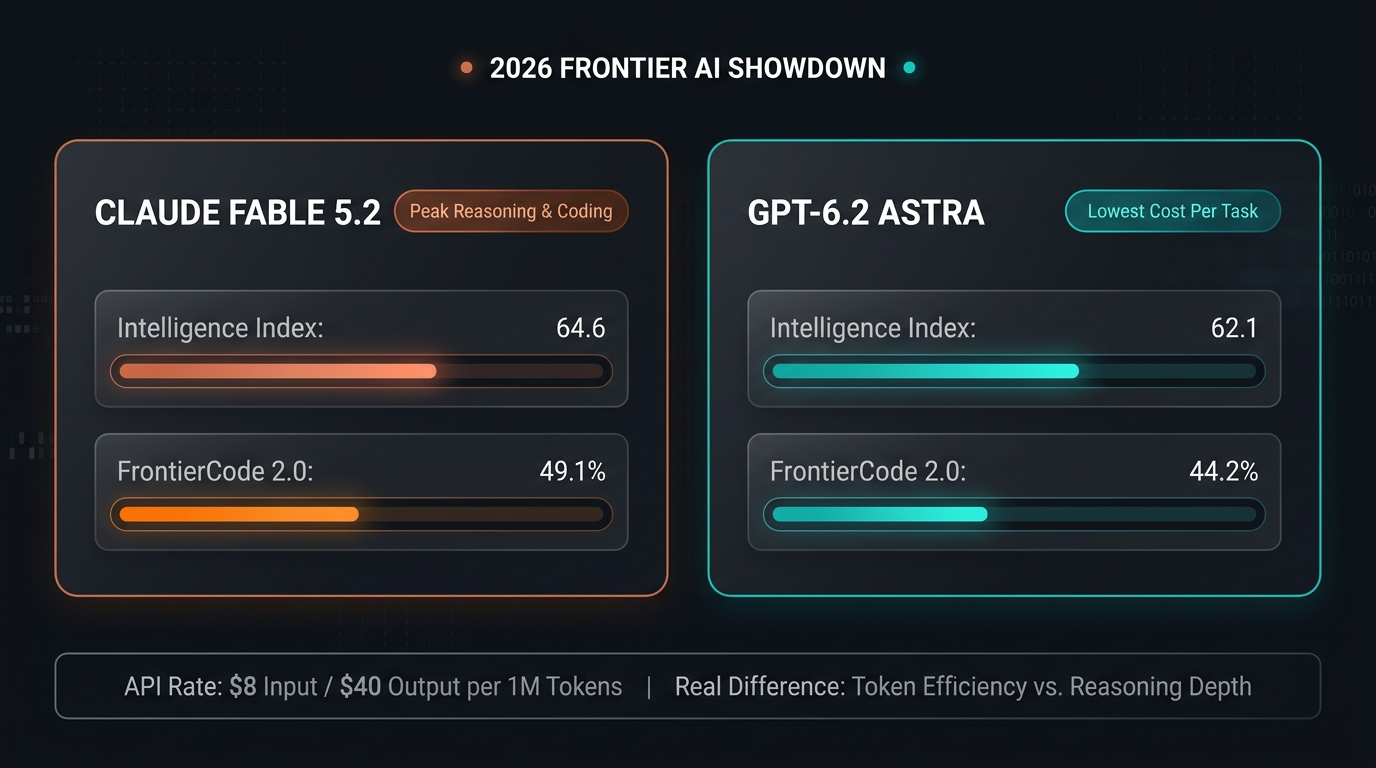
The battle for enterprise AI dominance just entered its sharpest phase yet. Within an eight-day window in November 2026, both frontier labs dropped their flagship architectures—forcing engineering leaders, CFOs, and CTOs to re-evaluate their 2027 cloud budgets overnight. In the Claude Fable 5.2 vs GPT-6.2 Astra showdown, the headline numbers tell one story, while real-world production bills tell another.
Anthropic introduced Claude Fable 5.2 and Claude Mythos 5.2 on November 9, 2026, setting a new bar for deep agentic reasoning. Eight days later, on November 17, 2026, OpenAI answered with GPT-6.2 Astra and GPT-6.2 Sol. As of November 17, Claude Fable 5.2 leads the Artificial Analysis Intelligence Index at 64.6 versus GPT-6.2 Astra's 62.1—extending Anthropic's seven-month lead at the top of the leaderboard. Yet identical $8/$40 API token rates mask a dramatic gap in real cost per completed task. Here is the complete commercial and technical breakdown to guide your migration strategy.
Executive Quick Verdict: Which Frontier Model Wins?
- Best for Peak Intelligence & Complex Agentic Coding: Claude Fable 5.2 (64.6 Intelligence Index; 49.1% on FrontierCode 2.0; 17-point lead on real-world Epoch workplace tasks).
- Best for Cost-Per-Task Efficiency & Production Scale: GPT-6.2 Astra (far lower reasoning token burn, concise default outputs, faster pipelines, and stronger visual/document deliverables).
- Best for Vetted Cybersecurity & Life Sciences Teams: Claude Mythos 5.2 (restricted dual-use sibling model powering Claude Security via trusted access).
- Smartest Enterprise Strategy: Hybrid Routing—run high-volume production workloads on GPT-6.2 Astra (or Claude Opus 5.5) and escalate mission-critical architectural reasoning to Claude Fable 5.2.
Head-to-Head Snapshot: Claude Fable 5.2 vs GPT-6.2 Astra at a Glance
Before diving into benchmark nuances and hidden token economics, here is how Claude Fable 5.2 vs GPT-6.2 Astra compare across the core metrics enterprise buyers audit first.
| Specification / Metric | Anthropic Claude Fable 5.2 | OpenAI GPT-6.2 Astra |
|---|---|---|
| Release Date | November 9, 2026 | November 17, 2026 |
| Companion Release | Claude Mythos 5.2 (Restricted Access) | GPT-6.2 Sol |
| Artificial Analysis Intelligence Index | 64.6 (Leader — 7-Month Streak) | 62.1 |
| FrontierCode 2.0 (Agentic Coding) | 49.1% | 44.2% |
| Standard API Pricing (Per 1M Tokens) | $8.00 Input / $40.00 Output | $8.00 Input / $40.00 Output |
| Fast / Ultrafast Tier (Per 1M Tokens) | $16.00 Input / $80.00 Output | $16.00 Input / $80.00 Output |
| Cached Input Read (Per 1M Tokens) | $0.20 (50% cheaper) | $0.40 |
| Real-World Cost Per Task | Higher (heavy reasoning token burn) | Significantly Lower (concise footprint) |
| Primary Enterprise Role | Deep orchestrator & multi-day engineering | High-volume production & visual deliverables |
Inside the November 2026 Releases: What Actually Changed?
Both labs took noticeably different product philosophies this cycle. Rather than releasing a single general-purpose upgrade, Anthropic split its frontier tier along safety and access lines, while OpenAI optimized aggressively for production ergonomics, multi-agent orchestration, and token efficiency.
Anthropic's Claude Fable 5.2 & Mythos 5.2 (November 9, 2026)
Anthropic's November 9 launch delivered two models built from the same underlying frontier architecture. Claude Fable 5.2 is the generally available flagship deployed across Claude apps, the Anthropic API, Amazon Bedrock, and Microsoft Foundry. Compared to Fable 5.1, it brings roughly a 30% speed improvement while pushing multi-step reasoning and long-horizon autonomy to new highs.
Its restricted twin, Claude Mythos 5.2, unlocks specialized dual-use capabilities that Anthropic gates behind vetted trusted-access programs for cybersecurity defenders and life sciences researchers—directly powering Claude Security. Crucially, Anthropic is transparent about workload fit: it still recommends Claude Opus 5.5 as a day-to-day workhorse and positions Claude Fable 5.2 as an architectural advisor and orchestrator for complex, multi-hour or multi-day autonomous workflows.
OpenAI's GPT-6.2 Astra & GPT-6.2 Sol (November 17, 2026)
OpenAI responded on November 17 with GPT-6.2 Astra alongside its sibling GPT-6.2 Sol, rolling out across ChatGPT, the OpenAI Responses API, GitHub, Amazon Bedrock, and OpenRouter. Astra marks an important internal milestone: it is the first externally released OpenAI model to meet the company's High threshold for AI Self-Improvement under its preparedness framework.
For enterprise developers, however, the biggest upgrades are practical. GPT-6.2 Astra introduces a native Multi-agent beta inside the Responses API, an Ultrafast latency tier for real-time applications, noticeably stronger visual and document deliverables (executive slide decks, financial spreadsheets, and 3D interface prototypes), and much more concise default outputs that strip away unnecessary verbosity.

Benchmark Breakdown: Why Anthropic Extended Its 7-Month Lead
Independent evaluations make one reality clear: there is no universal blowout winner across every domain. Instead, the benchmarks reveal a crisp split between raw autonomous problem-solving depth and structured professional execution.
Overall Intelligence (Artificial Analysis Intelligence Index: 64.6 vs. 62.1)
As of November 17, 2026, Claude Fable 5.2 holds a 64.6 score on the Artificial Analysis Intelligence Index compared to GPT-6.2 Astra's 62.1. At the frontier tier, a 2.5-point margin is meaningful—not just statistically, but strategically. It extends Anthropic's uninterrupted seven-month streak at the top of independent intelligence rankings, reinforcing buyer confidence among engineering teams that already migrated during mid-2026.
Agentic Coding & Monorepo Engineering (FrontierCode 2.0)
On FrontierCode 2.0, which evaluates end-to-end autonomous software engineering rather than isolated snippet completion, Claude Fable 5.2 leads at 49.1% versus GPT-6.2 Astra's 44.2%. In practical monorepo environments, that 4.9-point advantage shows up in multi-file root-cause debugging, long verification loops, dependency conflict resolution, and coordinating sub-agents without losing architectural context halfway through a refactor.
Real-World Workplace Tasks vs. Professional Deliverables
The divergence widens further on real-world enterprise evaluations. According to Epoch Automation Reports, while both models sit roughly tied on the baseline Epoch Capabilities Index (ECI), Claude Fable 5.2 outperformed GPT-6.2 Astra by 17 points on open-ended workplace assignments. On complex AI data center analysis tasks, Fable 5.2 achieved 98% compared to Astra's 65% average.
Where does OpenAI strike back? GPT-6.2 Astra leads on Agents' Last Exam, GDPval v2, and Harvey LAB-AA—benchmarks heavily weighted toward structured legal analysis, domain-specific science, and polished visual deliverables. When teams ask for a clean board deck, a formatted valuation model, or concise executive memos without babysitting prompts, Astra routinely delivers tighter, ready-to-send outputs.
| Benchmark / Evaluation Suite | Claude Fable 5.2 | GPT-6.2 Astra | Winner |
|---|---|---|---|
| Artificial Analysis Intelligence Index | 64.6 | 62.1 | Claude Fable 5.2 |
| FrontierCode 2.0 (Agentic Coding) | 49.1% | 44.2% | Claude Fable 5.2 |
| Epoch Automation Reports (Open-Ended Work) | +17 pts lead (98% Data Center task) | 65% average | Claude Fable 5.2 |
| Agents' Last Exam & GDPval v2 | Strong runner-up | Category leader | GPT-6.2 Astra |
| Harvey LAB-AA & Visual Deliverables | Thorough, more verbose | Leads legal & slides/3D | GPT-6.2 Astra |
The $8/$40 Pricing Illusion: Token Rates vs. Real Cost Per Task
If your procurement team compares Claude Fable 5.2 vs GPT-6.2 Astra solely by looking at the public API pricing table, both models look financially identical. Standard rates sit at exactly $8.00 per million input tokens and $40.00 per million output tokens. Fast and Ultrafast modes match dollar-for-dollar at $16.00 input / $80.00 output, and cache writes cost $10.00 per million tokens on both platforms.
The only headline discount belongs to Anthropic on cached input reads: $0.20 per million tokens on Claude Fable 5.2 versus $0.40 per million tokens on GPT-6.2 Astra—a 50% advantage for heavy long-context RAG or static codebase caching.
| Pricing Tier / Cost Metric | Claude Fable 5.2 | GPT-6.2 Astra |
|---|---|---|
| Standard Input / Output (per 1M tokens) | $8.00 / $40.00 | $8.00 / $40.00 |
| Fast / Ultrafast Mode (per 1M tokens) | $16.00 / $80.00 | $16.00 / $80.00 |
| Prompt Cache Write (per 1M tokens) | $10.00 | $10.00 |
| Prompt Cache Read (per 1M tokens) | $0.20 | $0.40 |
| Low-Effort Cost Per Task (Artificial Analysis) | ~$3.10 / task | ~$0.66 / task |
Here is the budget trap CFOs miss: token price is not task price. Because Claude Fable 5.2 thinks much deeper—burning far more internal reasoning and verification tokens before emitting a final answer—its effective cost per completed task is dramatically higher. On Artificial Analysis low-effort benchmarks, GPT-6.2 Astra completes tasks for roughly $0.66 per task versus $3.10 per task on Claude Fable 5.2. At maximum reasoning effort, that gap widens even further.
Practical 50-Developer Org Budget Scenario: Suppose your 50-person engineering team runs 10,000 automated PR reviews, test-generation jobs, and agentic triage tickets per month. Running every ticket on low-effort GPT-6.2 Astra (~$0.66/task) costs roughly $6,600/month. Routing all 10,000 tickets unconditionally through Claude Fable 5.2 (~$3.10/task) pushes your monthly bill to $31,000/month—nearly 4.7x higher. However, routing 85% of routine PRs to GPT-6.2 Astra and escalating only the hardest 1,500 architectural tickets to Claude Fable 5.2 lands at roughly $10,260/month while capturing peak accuracy where it actually counts.
Enterprise Readiness, Cloud Availability & Safety Governance
For regulated buyers, raw intelligence means little without cloud procurement alignment and zero-data-retention guarantees. Both models are widely accessible across hyperscalers:
- Anthropic Claude Fable 5.2 Ecosystem: Available directly via the Anthropic API, Amazon Bedrock, and Microsoft Foundry. Enterprises benefit from Anthropic's Responsible Scaling Policy (RSP) transparency, Enterprise Frontier Safeguards (EFS), and clear Zero Data Retention (ZDR) pathways. Security teams requiring offensive/defensive cyber capabilities can apply separately for Claude Mythos 5.2 through Claude Security's vetted access tier.
- OpenAI GPT-6.2 Astra Ecosystem: Available via the OpenAI Responses API, GitHub, Amazon Bedrock, and OpenRouter. OpenAI pairs Astra with its Deployment Safety Hub, built-in stateful multi-agent orchestration inside the Responses API, and refined prompt caching designed for high-concurrency SaaS backends.
Buyer's Decision Matrix: Which Model Should Your Team Choose?
Stop asking which model is universally "smarter" and map the model directly to your primary revenue-generating workflow:
- Software Engineering & DevOps Teams: Choose Claude Fable 5.2 for legacy monorepo migrations, hard root-cause debugging, and long-horizon autonomous coding agents. Pair it with GPT-6.2 Astra (or Claude Opus 5.5) for fast CI/CD PR summaries, unit tests, and IDE autocomplete pipelines.
- Financial, Legal & Management Consulting Firms: Lean toward GPT-6.2 Astra for contract review (Harvey LAB-AA), formatted spreadsheets, concise client decks, and structured regulatory memos. Keep Claude Fable 5.2 on standby for massive cross-document synthesis and open-ended strategy research.
- High-Volume SaaS & AI Agent Startups: Default to GPT-6.2 Astra. When unit economics determine gross margin, saving 3x–5x on cost per completed task—plus Ultrafast latency—keeps your product profitable at scale.
- Regulated & Cybersecurity Enterprises: Evaluate Anthropic's stack closely. The combination of Claude Fable 5.2 for general enterprise reasoning and vetted access to Claude Mythos 5.2 via Claude Security offers a clear edge for dedicated SecOps and life sciences organizations.
The Smart CTO Playbook: Multi-Model Routing Architecture
The highest-performing engineering organizations in late 2026 no longer standardize on a single vendor. Instead, they implement a lightweight intent router in front of their LLM gateway: 80% of high-volume, latency-sensitive, and concise production tasks route to GPT-6.2 Astra (or Claude Opus 5.5), while the hardest 20%—multi-file refactors, stalled agent loops, and deep research—escalate automatically to Claude Fable 5.2. You get Anthropic's 64.6 intelligence ceiling without paying frontier reasoning burn on routine prompts.
5-Step Migration Checklist Before Switching Models
Before shifting annual cloud commits between Anthropic and OpenAI, run this five-step engineering audit over a two-week sprint:
- Shadow-Test on 100 Real Production Tickets: Skip public leaderboards. Replay 100 historical GitHub issues, support escalations, or financial memos side-by-side through both APIs and score pass rates blindly.
- Measure Cost Per Resolved Task (Not Cost Per Token): Track total input tokens, reasoning/output tokens, and retry counts until human acceptance. Include failed-run retries in your CFO sheet.
- Audit Your Prompt Caching Hit Rates: If your agents repeatedly query massive static codebases or compliance manuals, factor in Claude Fable 5.2's $0.20/1M cached read advantage against GPT-6.2 Astra's $0.40/1M rate.
- Refactor Legacy System Prompts: GPT-6.2 Astra is concise by default—remove aggressive "be brief" constraints that may truncate necessary detail. Conversely, add explicit output-budget instructions and reasoning-effort caps on Claude Fable 5.2 to prevent runaway token burn.
- Validate Fallback & Rate-Limit Behavior: Test failover between AWS Bedrock, Microsoft Foundry, and direct APIs so a single-provider spike never stalls mission-critical production agents.
Frequently Asked Questions (FAQs)
1. Which is better in Claude Fable 5.2 vs GPT-6.2 Astra?
Claude Fable 5.2 is stronger for maximum reasoning depth, complex multi-file agentic coding (49.1% on FrontierCode 2.0), and open-ended workplace analysis, leading the Artificial Analysis Intelligence Index at 64.6. GPT-6.2 Astra (62.1) is better for cost-per-task efficiency, concise outputs, visual deliverables, and high-volume production pipelines.
2. What is the Artificial Analysis Intelligence Index score for Claude Fable 5.2 vs GPT-6.2 Astra?
As of November 17, 2026, Anthropic's Claude Fable 5.2 leads the Artificial Analysis Intelligence Index with a score of 64.6, ahead of OpenAI GPT-6.2 Astra's score of 62.1. This 2.5-point lead extends Anthropic's seven-month run at the top of the leaderboard.
3. Why does Claude Fable 5.2 cost more per task than GPT-6.2 Astra if API prices are the same?
Although both models charge $8 per million input tokens and $40 per million output tokens, Claude Fable 5.2 generates significantly more internal reasoning tokens to solve complex tasks. Consequently, GPT-6.2 Astra finishes equivalent low-effort tasks for roughly $0.66 compared to ~$3.10 on Fable 5.2.
4. What is the difference between Claude Fable 5.2 and Claude Mythos 5.2?
Both models launched on November 9, 2026 from the same underlying frontier architecture. Claude Fable 5.2 is broadly available across apps, APIs, AWS, and Microsoft Foundry with standard safeguards, while Claude Mythos 5.2 is restricted to vetted cybersecurity and life sciences organizations through trusted access programs powering Claude Security.
5. Is Claude Fable 5.2 or GPT-6.2 Astra better for agentic coding?
Claude Fable 5.2 holds the edge for deep autonomous engineering, scoring 49.1% on FrontierCode 2.0 versus GPT-6.2 Astra's 44.2%. It excels at multi-hour monorepo refactoring and root-cause debugging, while GPT-6.2 Astra is frequently preferred for faster, lower-cost daily coding automation and Responses API multi-agent workflows.
6. Should enterprises migrate completely from OpenAI to Anthropic in late 2026?
A full single-vendor migration is rarely optimal. Because both models are available on Amazon Bedrock and major gateways, most CTOs achieve the best ROI using a hybrid architecture—deploying GPT-6.2 Astra for high-volume, cost-sensitive workloads and reserving Claude Fable 5.2 for their hardest architectural and analytical problems.
Final Verdict: Who Wins the 2026 Frontier Model Race?
The Claude Fable 5.2 vs GPT-6.2 Astra rivalry proves that late-2026 AI procurement is no longer a simple race for the highest benchmark trophy. Anthropic decisively defended its intelligence crown—holding 64.6 vs. 62.1 on the Artificial Analysis Intelligence Index, leading FrontierCode 2.0 by nearly five points, and dominating open-ended Epoch workplace tasks. Yet OpenAI engineered a formidable commercial counterpunch: GPT-6.2 Astra wins where enterprise margins live, slashing cost per completed task while leading in structured legal, scientific, and visual deliverables.
Your Next Step: Do not lock into a single-vendor 2027 commit based on headline $8/$40 sticker pricing. Spin up a 100-ticket shadow benchmark on your own production repositories this week, measure real cost per resolved task across both models, and build a hybrid routing layer that puts peak intelligence and peak efficiency to work side by side.
Reader Discussion (0)
Community ForumContribute perspectives, technical analysis, or questions below.